


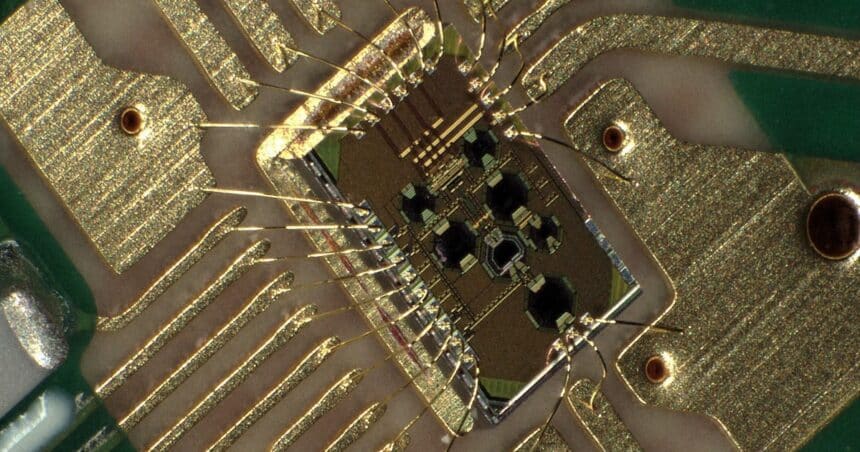
The development of a new radiation resistant Wi-Fi chip marks a massive leap forward for hazardous engineering projects. Jointly created by the Institute of Science Tokyo and the High Energy Accelerator Research Organization, this semiconductor can withstand up to 500 kilograys of extreme radiation. Currently, engineers rely on wired robots to navigate the highly toxic ruins of the Fukushima Daiichi nuclear power plant because standard wireless tech fails under intense gamma rays. By implementing this advanced radiation resistant Wi-Fi chip, response teams can finally switch to wireless drones and robots, drastically reducing the radiation exposure risk for human workers.
Engineering for Extreme Environments
To build a truly radiation resistant Wi-Fi chip, researchers had to fundamentally rethink traditional semiconductor design. Intense radiation usually causes electrical leakage and severely degrades signal strength in standard silicon components. To bypass this, the engineering team deliberately reduced the total number of transistors inside the receiver, replacing vulnerable parts with heavy-duty inductors that are naturally immune to radiation damage. Additionally, they upsized the remaining transistors, as larger components are significantly tougher against atomic bombardment. The resulting radiation resistant Wi-Fi chip successfully maintained stable wireless communication at levels 1,000 times higher than standard space-grade hardware.
Beyond Fukushima and Into Deep Space
The potential applications for this radiation resistant Wi-Fi chip extend far beyond local disaster zones and terrestrial cleanup operations. Eliminating bulky physical cables removes a massive bottleneck in maneuverability, allowing multiple robotic units to operate simultaneously without getting tangled. Beyond down-to-earth decommissioning tasks, this robust radiation resistant Wi-Fi chip is primed to revolutionize space exploration infrastructure. Future rovers, satellites, and deep-space probes equipped with this technology will easily endure the punishing cosmic radiation fields of the solar system, ensuring reliable data transmission where conventional electronics would instantly fry.