


 EN
EN
1. Introduction
onsabe.com – The recent rise in RAM prices has taken many people by surprise, especially those looking to upgrade their PC or laptop or build a new PC. This phenomenon isn’t just a matter of “prices being high right now,” but rather the result of several major factors in the global memory industry.
2. Surge in Demand from the AI and Data Center Industries
One of the biggest drivers is the explosive growth in the use of AI (Artificial Intelligence) and data centers.
- Tech giants such as Google, Microsoft, Amazon, Meta, OpenAI, and others are building massive AI data centers.
- These AI servers require massive amounts of DRAM and, in particular, HBM (High Bandwidth Memory) to train and run AI models.
- As a result, a significant portion of memory production capacity is being absorbed by the server and AI segments, causing the supply of “standard” DRAM for consumer PCs and laptops to dwindle.
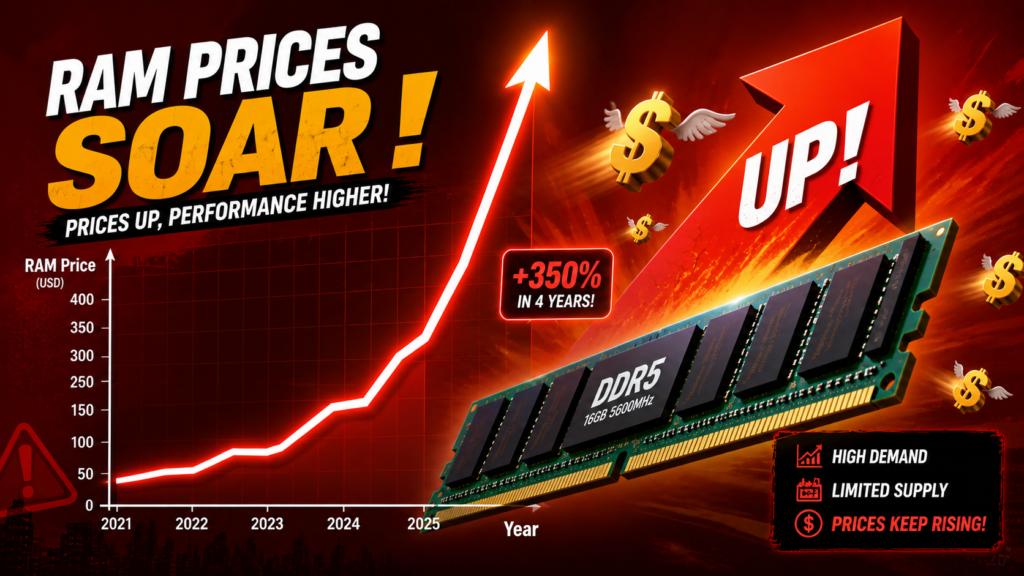
According to several market analyses, contract prices for DRAM are set to surge throughout 2025
3. Basic Economic Principle: High Demand, Low Supply
In simple economic terms, when demand rises while supply is limited, prices automatically go up.
- RAM is now used in PCs, laptops, smartphones, servers, game consoles, IoT devices, and even cloud computing infrastructure.
- Memory manufacturers often prioritize large orders from smartphone vendors and data centers because of the high volume and higher margins.
- As a result, the supply of DRAM chips for the consumer PC market has decreased, leading to a shortage of available products despite high demand.
4. Memory Manufacturers Deliberately Cut or Shift Production
The memory market is known for its boom-and-bust cycles. When prices dropped, major manufacturers like Samsung, SK Hynix, and Micron cut production to keep prices from falling too low.
Recently, as demand for AI has surged, they have:
- Shifted production capacity from standard DRAM to HBM and premium memory for servers and AI.
- Focused on high-margin products, as they are more profitable.
As a result, consumer DRAM inventory (DDR4/DDR5 for standard PCs and laptops) has become increasingly scarce, causing retail prices to rise.
5. The More Complex Transition to DDR5 Technology
The market is also transitioning from DDR4 to DDR5.
- DDR5 has a more complex structure and architecture than DDR4, resulting in higher production costs and greater manufacturing complexity.
- Early in the transition period, yields (the percentage of functional chips per wafer) were not yet optimal, making the cost per chip higher.
- Many new platforms (the latest generation of CPUs and motherboards) now require DDR5, causing demand for DDR5 to rise rapidly, while manufacturers are still adapting.
The combination of rising demand for DDR5 and production that has yet to reach optimal levels is driving up RAM prices, particularly for DDR5.
6. Manufacturer Concentration (The Big Three)
The global DRAM market is dominated by three major players: Samsung, SK Hynix, and Micron.
- Since just a few companies control the majority of the market, their decisions to cut or shift production can directly impact global prices.
- When they collectively curb production or shift their focus to more profitable AI memory, the effects are immediately felt in PC RAM prices in Indonesia and other countries.
7. Impact on Regular PC/Laptop Users
For home users and gamers, the noticeable effects:
- The cost of upgrading RAM has risen significantly, especially for DDR5 and high-capacity modules (16 GB and above).
- Prices for new laptops and PCs with large amounts of RAM have also gone up, as component costs have increased.
- Stores and distributors often have limited stock, so discounts are rare, and prices tend to remain stubbornly high.
Some analyses even suggest that RAM prices could rise by as much as 500% in 2025 under certain scenarios, particularly for certain types that are in high demand.
8. Tips for Dealing with High RAM Prices
If you happen to be caught at a bad time when RAM prices are rising, here are a few strategies to consider:
- Optimize your existing RAM first
- Close unnecessary resource-intensive apps, use your browser sparingly, and take advantage of ReadyBoost (Windows, though limited) or other optimization software.
- Consider a gradual upgrade
- If you’re still on DDR4 and your needs aren’t extreme yet, adding used or new DDR4 modules is sometimes cheaper than jumping straight to a full DDR5 platform.
- Buy a bundle (complete PC/laptop)
- Some laptop or custom PC manufacturers sometimes have better pricing agreements with manufacturers, so the price difference for RAM feels more manageable when included in a package.
- Monitor promotions & stock
- Take advantage of flash sales, seasonal discounts, or clearance sales when stores want to clear out specific inventory.
- Match your needs to your budget
- For office work or light browsing, 8–16 GB is often sufficient; there’s no need to force 32–64 GB unless you actually need it for heavy editing, VMs, or local AI.
Summary
- RAM prices have risen primarily due to a surge in demand from the AI and data center industries, which are consuming large quantities of DRAM and HBM.
- The supply of DRAM for consumers has decreased, exacerbated by manufacturers shifting production to AI memory and premium memory.
- The transition to the more complex and expensive DDR5, combined with a market structure dominated by a few major manufacturers, is also making it difficult for prices to fall.
- As a result, upgrading PC/laptop RAM has become significantly more expensive, but users can still work around this through optimization, gradual upgrades, and taking advantage of promotions.
Source :
– kumparan.com
– gkomunika.com
– axiooworld.com
– tekno.kompas.com